The Living Architecture and Hidden Wisdom of the Manggarai People
A journey through mbaru niang, compang, and the four villages of western Flores
— Wana Wanua —
Imagine stepping inside a house that is simultaneously a forest archive, a legal document, a prayer, and a map of the cosmos.
That is what you experience the moment you enter a mbaru niang.
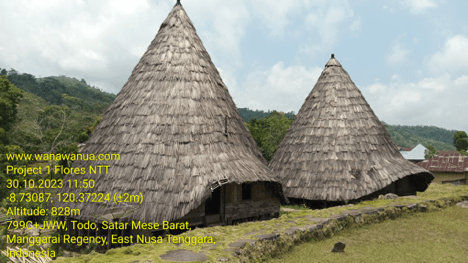
The mbaru niang is the traditional round house of the Manggarai people of western Flores, Indonesia. From the outside, it rises from the earth like a great thatched mountain — no visible walls, no windows, just a sweeping cone of dark palm fibre tapering to a single point far above your head. Its roof is layered so thickly with ijuk (sugar palm fibre) that during a heavy tropical downpour, the sound from inside resembles distant thunder. Striking enough to fill tourism brochures, UNESCO heritage reports, and Instagram feeds the world over.
But if you think the mbaru niang is simply a beautiful old building, you have only seen its skin. Peel back the thatch, and you will find one of the most remarkable examples on earth of how a community encodes its entire existence — its laws, its ecology, its history, its identity — into a single physical structure.
“We at Wana Wanua walked through four Manggarai villages — Melo, Todo, Ruteng Pu’u, and Waerebo. This is what the houses told us.”
Getting to Know the Manggarai People
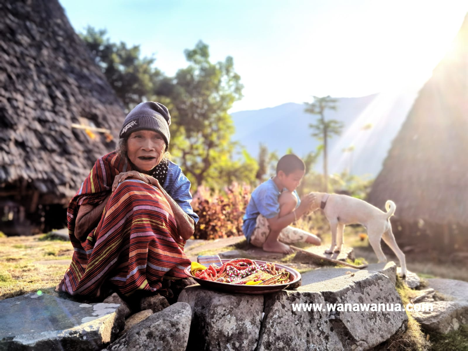
The Manggarai number approximately 350,000 people and inhabit the western third of Flores Island, in Indonesia’s East Nusa Tenggara Province. They are predominantly Catholic — a legacy of centuries of colonial influence — yet Catholicism sits comfortably alongside a deep, thriving system of ancestral belief and customary law known as adat.
Manggarai society is organised around clans (wa’u), territorial communities (beo), and ritual domains centred on sacred stone altars called compang. The social logic is one of constant tension: lineages dispersing outward across a rugged volcanic landscape, then being drawn back together at ceremonial centres to reaffirm the ties that bind them.
Two Words That Unlock Everything
Before going further, two Manggarai concepts must be understood — because they are the keys to reading the house, the village, the fields, and the entire worldview of this people.
🌱 PU’U — Root, Origin, Trunk. In Manggarai thought, everything has a pu’u — a source it comes from, a root that anchors it. People have pu’u (their ancestral lineage). Land has pu’u (the original claim that gives it identity). Even a village name can carry pu’u — Ruteng Pu’u literally means ‘the original Ruteng,’ the trunk from which the wider town grew. When something has pu’u, it carries legitimacy, history, and the blessing of those who came before.
🪨 COMPANG — The Sacred Stone Altar. The compang is the circular stone altar standing at the centre of every traditional Manggarai settlement. Before you can understand the house, you must understand this altar — because in Manggarai cosmology, the compang is the heart of everything. The house orbits it. The village organises itself around it. The ancestors dwell within it.
Part One: Reading the Building Before You Step Inside
Before crossing the threshold, stand back and take in the building as a whole. Every element you see — its shape, its materials, its symbols — is telling you something.
The Circle: A Philosophy of Balance
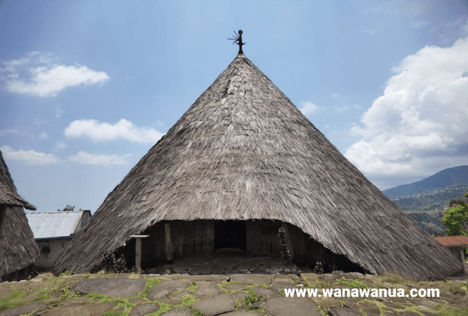
The first thing you notice is the shape: perfectly round, perfectly conical. This is no accident of engineering. In Manggarai thought, the circle is the shape of balance and harmony. It has no beginning and no end. No side is more important than another; no corner more privileged.
This philosophy extends from the house outward to the entire landscape. Look at any traditional Manggarai settlement from above and you will see concentric circles: the compang altar at the centre, the mbaru niang arranged in a ring around it, and beyond the village, the lingko fields spreading outward like a spider’s web. Circle within circle within circle — everything in relationship to a single centre.
The Roof: A Cosmic Mountain
A mbaru niang can rise to 15 metres in height. In the highland mist of Waerebo, its cone of black ijuk fibre seems to emerge from the clouds themselves. The multi-tiered thatched roof is not merely a shelter — it is a diagram of the Manggarai universe:
| Section of the Roof | Cosmological Meaning |
| The wide base | The world of the living — where people work, eat, sleep, and gather |
| The middle tiers | The world of transition — where the gifts of the earth are cared for |
| The pointed apex | The world of ancestors and the divine — Mori Kraeng (the Lord) |
Every time a Manggarai person glances at this roofline, they are reading a map of existence.
Ijuk: The Intelligence of the Roof
The thick, dark outer surface of the mbaru niang is made primarily from ijuk — the fibrous hair of the sugar palm (aren). This material was not chosen for its appearance. It was chosen because it works.
Ijuk is naturally water-resistant, insect-repellent, and extraordinarily durable in tropical conditions. Layered correctly — using techniques handed down through generations — it manages intense highland rainfall, regulates interior temperature without any modern technology, and lasts seven to ten years before renewal. Crucially, the roof extends all the way to the ground. There are no separate walls. The roof is the house — a continuous surface from apex to earth, giving the building near-perfect aerodynamic stability against the highland winds that sweep through the Manggarai mountains.
The Single Door: Deliberate Darkness
The traditional mbaru niang has only one door and no windows. It is positioned at the front of the building and serves as both entrance and exit.
One door. No windows. This seems strange until you understand the logic behind it. The single entrance keeps the interior deliberately protected — from wind, from rain, and from spiritual intrusion. In Manggarai cosmology, a house with many openings is a house with many vulnerabilities. The darkness inside is not a design flaw; it is a feature. It creates a boundary between the public world outside and the sacred, ancestral world within. To step through that low doorway is to cross a threshold — from the ordinary into the communal and the sacred.
Rangga Kaba: Buffalo Horns at the Summit
Look carefully at the apex of a traditional mbaru niang — particularly the mbaru gendang, the clan’s ceremonial drum house — and you will often see rangga kaba: buffalo horns mounted at the very top.
The cone with its buffalo horns is a symbol of strength. But the meaning runs deeper. In Manggarai culture, the buffalo (kaba) is the supreme symbol of vitality, hard work, and sacred worth. Buffalo are sacrificed at the most significant ceremonies — weddings, house dedications, funerals. To mount the horns at the highest point of the house is to dedicate the entire structure to the values the buffalo embodies: endurance, communal effort, and the willingness to give everything for the good of the community. The horns point upward toward Mori Kraeng — a declaration that the life of this community is oriented toward the divine.
Siri Bongkok: The Post That Holds the Universe
You cannot see the siri bongkok from outside, but it is worth understanding before you enter, because it is the heart of the entire structure.
The siri bongkok is the central post — the main column of worok hardwood running from the earthen floor straight up through every level to the very apex of the cone. This is the post at which offerings are placed for the ancestors; it is considered deeply sacred.
Architecturally, the siri bongkok is the structural spine of the building. Spiritually, it is the axis of the world — the point where earth, the human realm, and the heavens converge. In ritual speech, it is sometimes described as ‘the mother who brings fertility and prosperity.’ The ceremonial drum (gendang) and gong are hung from it.
Surrounding the siri bongkok are eight outer support posts called siri leles — a ring of columns that distributes the load of the roof and echoes the circular logic of the entire structure. Eight posts, one centre. Exactly like the spider-web fields beyond the village: eight radiating strands, one lodok at the heart.
No Nails, No Metal: The Engineering of Resilience
The mbaru niang is built using traditional binding technology rather than nails or metal fasteners. Counterintuitively, the absence of nails is precisely what makes it stronger.
A nail-bound structure is rigid — and rigidity is a liability in an earthquake, because rigid joints snap under lateral force. A rope-bound structure is flexible: it sways, absorbs the shock, and returns to position. The Manggarai highlands sit in one of the most seismically active regions of Indonesia, and the mbaru niang has understood this for centuries. Every joint is bound with rattan or ijuk rope. The bamboo members flex. The whole structure breathes.
Part Two: The Village Layout — The House Within Its Cosmos
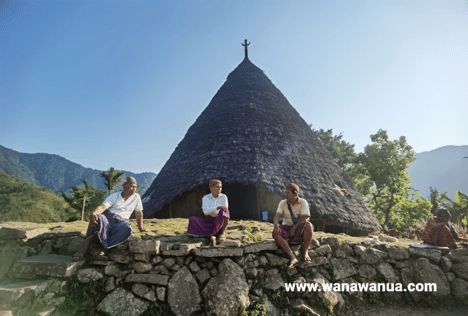
Before stepping inside, take a further step back and see the full picture. The mbaru niang does not stand alone. It is one part of a far larger cosmological system.
Gendang Oné, Lingko Péang — House Inside, Garden Outside
There is a Manggarai phrase that perfectly captures how the mbaru niang fits into the wider world: gendang oné, lingko péang — ‘house inside, garden outside.’ It embodies the inseparable unity of domestic life, communal labour, and divine order. The house and the field are not separate things. They are two expressions of the same philosophy — and remarkably, they share the same shape.
The Compang: Sacred Altar at the Centre of Everything
At the middle of the circle of houses stands the compang — the most sacred location in any traditional Manggarai settlement. It is used to honour God and the spirits of the ancestors.
The compang is a raised circular stone platform positioned at the very centre of the village. It is not large, but it is the point around which everything else orbits. Here, sacrificial animals — most importantly buffalo — are slaughtered during major ceremonies. Libations of palm wine are poured to the ancestors. The community formally addresses the invisible world that sustains it. In some villages, the compang also contains the graves of important ancestors, making it literally a place where the living and the dead share ground.
The compang functions simultaneously as:
| Function | Explanation |
| Ritual altar | The site of sacrifice, ceremony, and offering |
| Cosmological centre | The earthly counterpart of the siri bongkok inside the house |
| Territorial marker | An assertion that this community is ancestrally rooted in this place |
| Legal instrument | A claim — grounded in adat — over the surrounding land |
Lingko: Spider-Web Rice Fields — The Same Logic, Extended to the Land
Walk away from the village, climb the hills above Cancar or look out beyond Ruteng Pu’u, and you will see something extraordinary from above: rice fields arranged in perfect concentric circles, divided into triangular wedges radiating outward from a single central point — exactly like a spider’s web.
These are the lingko fields, and they are not separate from the mbaru niang. They are the same philosophy extended to the landscape. The central point of the circle — the lodok — represents the heart of the community. From it, the fields radiate outward like the strands of a web, symbolising unity and shared responsibility. Historically, plots were allocated according to family size and communal contribution.
The parallel between house and field is precise:
| Inside the Village | Out in the Fields |
| Siri bongkok (central post) | Lodok (central point of the lingko) |
| Siri leles (8 outer posts) | The radiating field divisions |
| Compang (communal altar) | Teno (the central wooden pole) |
| Mbaru niang (circular house) | Lingko (the circular field) |
Circle, centre, radiating lines. This is the Manggarai grammar of space — applied equally to where you sleep and where you plant your rice.
Part Three: The Interior — A Vertical Journey Through the Universe
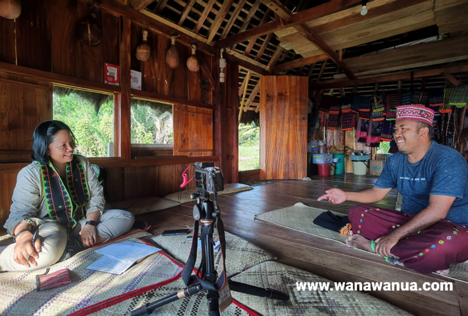
Step through the single door now, and let your eyes adjust to the darkness.
Inside the mbaru niang, the house is divided vertically into six levels, each with a specific function and a specific cosmological meaning. To move upward through these levels is to travel from the human world toward the ancestral — from the practical toward the sacred.
| Level | Name | Function | Symbolic Meaning |
| 0 | Ngaung | Tools, weaving equipment | The underworld; the realm of the dead |
| 1 | Tenda / Lutur | Daily living, hearth, ceremony | The human world |
| 2 | Lobo | Food storage | Present abundance |
| 3 | Lentar | Emergency food reserve | Resilience in hardship |
| 4 | Lempe Rae | Seed storage | The future |
| 5 | Hekang Kode | Ancestral altar, sacred objects | The spiritual world; the ancestors |
Level 0 — Ngaung: The Underworld
Before you reach the living space, there is a level below: ngaung, the space beneath the raised floor between the earth and the base of the structure. Ngaung symbolises the world below — in Manggarai cosmology, the realm of darkness, the dead, and unseen spiritual forces. Practically, it is used for storing tools, weaving equipment, and gardening implements. Cosmologically, it is the foundation on which the human world rests — an acknowledgment that the living always sit above the world of those who came before.
Level 1 — Tenda (Lutur): The Human World
Tenda is the ground floor — the living level. This is where daily life unfolds: cooking, eating, conversation, sleep, welcoming guests, holding ceremonies. Extended families — sometimes thirty to forty people across multiple generations — share this space.
This level is organised around the hapo — the hearth. The hapo is far more than a cooking fire. It is the emotional and spiritual heart of each family’s space within the house. Each household cluster within the mbaru niang has its own hapo, typically consisting of three stones arranged in a triangle (the lutur). These three hearthstones represent the three core relationships of Manggarai life: the bond with the ancestors, the bond with the living community, and the bond with the land.
Rooms (molang) branch off from the central space, arranged according to family structure and clan seniority. Who sleeps where is never arbitrary — birth order, clan position, and generational standing all determine a family’s place within the house. No shoes are worn inside. Voices are kept respectful. The tenda is a sacred-social space where the rules of living together are not written on paper but built into the very layout of the room.
Level 2 — Lobo: The Provisions Store
Lobo is the second level, directly above the living area, and it stores food supplies and household goods. In a highland agricultural community, food security is everything. Lobo is the buffer between abundance and shortage — the family’s reserve. In Manggarai thought, full stores are a sign of the ancestors’ blessing; an empty lobo signals that the relationship with the invisible world needs attention.
Level 3 — Lentar: The Emergency Reserve
Lentar sits above lobo and serves as longer-term storage for when harvests fail. Should the rains not arrive, should the harvest fall short, should drought descend — lentar is the community’s safety net. Its very existence speaks to centuries of living with agricultural uncertainty in the highlands of Flores. The Manggarai did not build only for optimistic times. They built for the worst year.
Level 4 — Lempe Rae: The Seed Vault
Lempe Rae is dedicated entirely to the storage of seeds — specifically, the seeds for the next planting season. This level embodies a profound ecological intelligence. You may eat your provisions. You may draw down your emergency reserve. But you must never consume the seeds. Without seeds, there is no next harvest. Without the next harvest, there is no future.
“Lempe Rae is the future of the community — stored safely above the pressures of the present, protected by every level below it.”
Level 5 — Hekang Kode: The Ancestral Realm
At the very apex of the house, directly beneath the peak of the cone, lies the most sacred level of all: Hekang Kode. Here, there is nothing but an ancestral altar. This floor is accessed only during house dedication ceremonies. Sacred objects, ancestral heirlooms, and ritual items are kept here, as close as possible to the spiritual realm above.
Hekang Kode is not a room for living. It is a room for remembering — for honouring, and for maintaining the connection between the community and those who established it. No one climbs to Hekang Kode casually. Access is restricted to specific ritual moments: when the house is first dedicated, when major transitions occur in the life of the community, or when the bond with the ancestors requires formal renewal.
“From the dead below, through the living in the middle, to the ancestors above. The house is a vertical map of time — past, present, and future — all beneath a single cone.”
Part Four: The Rituals That Keep the House Alive
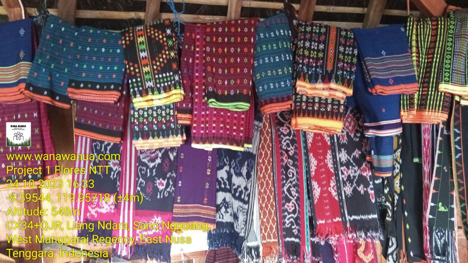
A mbaru niang is not simply constructed. It is born through ceremony, sustained through ceremony, and mourned through ceremony if it is lost.
| Ceremony | Meaning and Purpose |
| We’e Mbaru | The ceremony of first habitation. Before anyone sleeps inside, the house must be formally introduced to the ancestors — the compang receives offerings, the siri bongkok is ritually addressed, and the community gathers to eat, drink palm wine, and fill the new space with voices and life. A house that has not undergone We’e Mbaru is not yet alive. |
| Barong Compang | The ceremony to invoke the ancestral spirit who guards the village compang. When the community faces hardship — drought, conflict, illness, uncertainty — this ritual is performed to renew the bond between the living and the invisible guardian who watches over the altar and the territory it represents. |
| Barong Wae | The ceremony to summon the spirit who guards the sacred spring. Water is life in the Manggarai highlands, and the springs that feed the community’s fields are understood as sacred. This ritual is a formal acknowledgment that access to water is not a right to be taken for granted — it is a relationship to be maintained. |
| Tae Mata | The ritual of departure. When someone dies, this ceremony formally releases their spirit from the community of the living and entrusts them to the world above — eventually to Hekang Kode, where the ancestral presence is concentrated. In the world of the mbaru niang, death is not an ending. It is an elevation. |
Part Five: What the Building Is Made Of — And Why It Matters
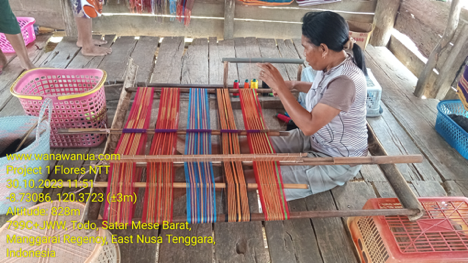
Every material in a mbaru niang was chosen with intention, and every material comes from the surrounding landscape. To build a mbaru niang is, therefore, also an act of negotiating with the land and the community — an assertion of territorial belonging and a reciprocal relationship with the forest.
| Material | Function and Significance |
| Worok hardwood | Forms the siri bongkok (central post) and primary structural elements — valued for its exceptional hardness and durability in the humid highland environment. |
| Uwu, Moak, Rukus, Wuhar, Hewang, Wojang, Kenti | Local hardwoods used for beams, joists, braces, and ring beams — each selected for specific structural properties understood through generations of building practice. |
| Bamboo | Used for secondary framing, floor ties, and roof rafters — flexible, abundant, and strong under tension. |
| Rattan and ijuk rope | All binding — the nail-free technology that gives the structure its earthquake resilience and allows it to flex and breathe. |
| Ijuk palm fibre | The roof covering — water-resistant, insect-repellent, and capable of passive thermal regulation that keeps the interior cool by day and warm at night. |
None of these materials appear from nowhere. They are harvested from forests that belong to specific clans, under specific social protocols, often with ritual speech that must be spoken before a tree may be felled. This is why, when Waerebo was rebuilt, the question of where the timber could come from was never merely a practical one. It was simultaneously an ecological question, a genealogical question, and a legal question. The mbaru niang is built from the land it stands on. The two are inseparable.
Part Six: Four Villages, Four Expressions of the Same Wisdom
Each of these four villages navigates its own pressures, its own relationship with tourism, government, and time. Yet in all four, the siri bongkok still stands at the centre. What differs is how each community holds it upright — and those differences make each story its own.
Village 01 Melo
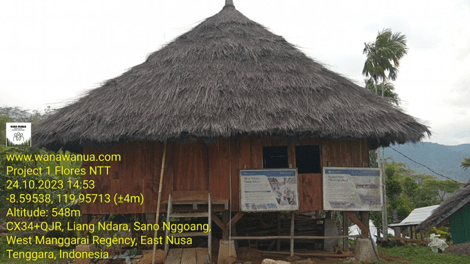
The Village That Learned to Perform for the World
Melo sits roughly fifteen kilometres north of Ruteng, the regional administrative capital, and has become one of the most accessible entry points into Manggarai cultural life. Visitors are welcomed with formal rituals, treated to demonstrations of caci — the spectacular Manggarai ritual whip-duel — and guided through the village’s compang and mbaru niang alongside local guides.
It would be easy to dismiss this as staged tourism. But something far more interesting is at work. Melo has developed a kind of double life: the village sustains its internal ceremonial world while running a parallel cultural showcase for outside visitors. The two are not identical, but neither do they cancel each other out. Young men who perform caci for tourists gain income and a new form of recognition — alongside, not in place of, older structures of ritual authority. The elders still conduct ceremonies that no tourist ever witnesses.
“The real question is whether, behind the performance, the houses remain alive. In Melo, they do. The house is not a museum exhibit. It is still home.”
Village 02 Todo
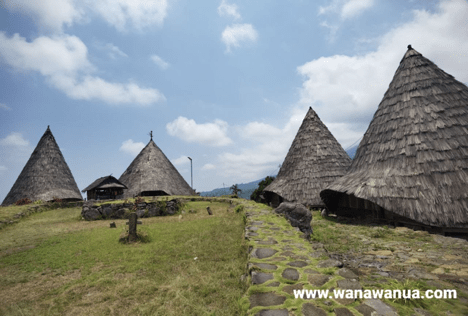
The Weight of a Kingdom Remembered in Timber
If Melo faces outward toward the world, Todo faces inward — toward memory. Todo was once the dominant political centre of western Flores. At the height of its power in the 17th and 18th centuries, the kingdom’s lords — the Dalu — exercised authority over a vast surrounding territory. The name ‘Todo’ still carries extraordinary weight in Manggarai consciousness as a byword for aristocratic legitimacy.
Today, the formal privileges of Todo’s nobility are long gone — dissolved first by Dutch colonial reorganisation, then by the Indonesian state, which restructured local government in ways that left no room for hereditary chiefs. What remains is cultural authority: the claim that Todo is the true heart of Manggarai civilisation.
That claim is kept alive through the built environment. Walking through Todo, you feel it in the arrangement of the houses, in the placement of the compang, in the way elders speak about the land. In Manggarai cosmology, the land itself is not a passive backdrop to social life — it is an active presence, capable of supporting or withdrawing from a community depending on whether its ceremonial obligations are fulfilled.
“To stand in Todo is to read a building as a memory system. The architecture holds what the political system can no longer carry.”
Village 03 Ruteng Pu’u
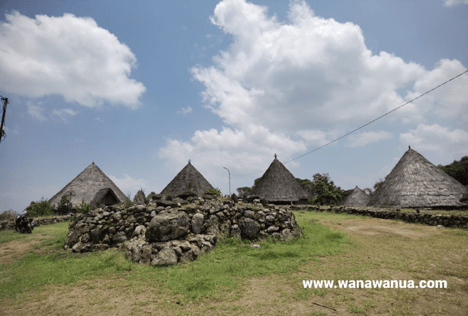
The Politics of Being the Original
The name says everything: Ruteng Pu’u means ‘the original Ruteng’ — the ancestral trunk settlement from which the regional capital and its surrounding communities grew. This is not a casual label. It is a claim woven into the very identity of the village.
Ruteng Pu’u is simultaneously a small traditional highland community and the symbolic point of origin for a busy urban area that has long since overtaken it in economic and administrative terms. The city of Ruteng has the government offices, the markets, the schools. But Ruteng Pu’u has pu’u — and in Manggarai logic, that is a form of authority no government charter can create or dissolve.
The compang at Ruteng Pu’u — now attended by regional officials and urban residents whose daily connection to adat has thinned — functions as a living declaration: we were here first, our roots run deepest, and the decisions that shape this land should begin with us.
“Traditional built environments are never passive relics. They are active arguments in an ongoing conversation about who belongs where, and why.”
Village 04 Waerebo
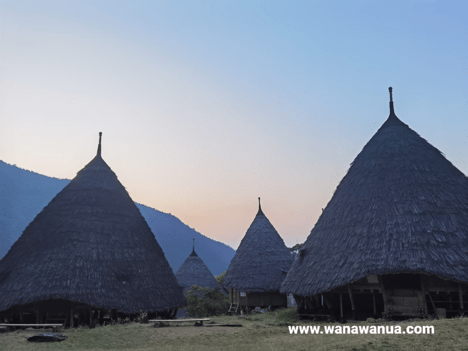
The House That Remembered Itself
Waerebo is the most famous, the most remote, and in many ways the most instructive of the four. Perched in a mountain valley at 1,200 metres above sea level, accessible only by a three-to-four-hour trek through dense highland forest, its seven mbaru niang have become icons of Indonesian heritage, earning the UNESCO Asia-Pacific Heritage Award in 2012.
By the 1990s, several of Waerebo’s mbaru niang had fallen into severe disrepair. By 2008, only four remained standing. The rebuilding project — supported by an architecture team working closely with the community’s own elders — did not simply restore timber and thatch. It recovered a knowledge system.
Building a mbaru niang demands knowing the forest, the ritual, the material, the proportion, and the social protocol. That knowledge does not live in a manual. It lives in people — in tu’a (master craftspeople) who learned by doing. When the community rebuilt, they rebuilt not merely the house but their own capacity to be the people who build such houses.
After the conservation effort, the count of mbaru niang returned to seven. Each was given a name: Niang Gendang, Niang Gena Mandok, Niang Gena Jekong, Niang Gena Ndorom, Niang Gena Keto, Niang Gena Jintam, and Niang Gena Maro. Each name is a story. Each story is still being told.
“What was conserved at Waerebo was not a building. It was a practice. And the liveliness of the rebuilt houses is evidence that the knowledge system behind them was successfully passed to a new generation.”
Part Seven: The House as Four Things at Once
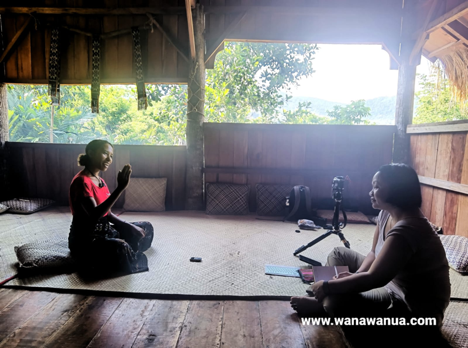
What makes the mbaru niang so extraordinary is that it is never just one thing. Across all four villages, it functions in four overlapping dimensions simultaneously.
🌿 A Living Ecological Archive. Every material in the mbaru niang — the specific timber of the central post, the particular bamboo species woven into the structure, the layered ijuk — is an environmental record. This knowledge cannot be split into ‘technical’ and ‘cultural’ components. Remove the social and spiritual dimensions, and you do not get a simpler version of the knowledge. You get something that no longer functions.
⚖️ A Living Legal Document. Three legal systems operate simultaneously in every Manggarai village: Indonesian state law (governing land, forests, and tourism); Manggarai customary law (adat), which recognises the compang as a territorial centre and vests authority in clan heads; and the Catholic Church, which adds its own layer of jurisdiction over what may be performed at the ancestral altar. The compang is an adat claim over the surrounding land — recognised or not by the state.
🌍 A Territorial Claim. Who controls access to the forests that supply building materials? When the government designates land as a protected area or tourism zone, whose knowledge of that land suddenly becomes invisible? Every mbaru niang is, among other things, a record of a community’s capacity to hold its ground — against neighbouring clans, state forestry agencies, and tourism industries that would rather see managed forests as scenic backdrop than as living commons.
📚 A Knowledge Transmission System. When a mbaru niang is not built, a body of knowledge dies. When it is rebuilt, that knowledge lives again. The know-how required to build a traditional round house — its proportions, its materials, its ritual sequence, its relationship to the local landscape — does not exist in books or databases. It exists in people. As the Waerebo story shows, it can be recovered — but only through the act of building itself, guided by those who still carry it.
Closing: A House Is Never Just a House
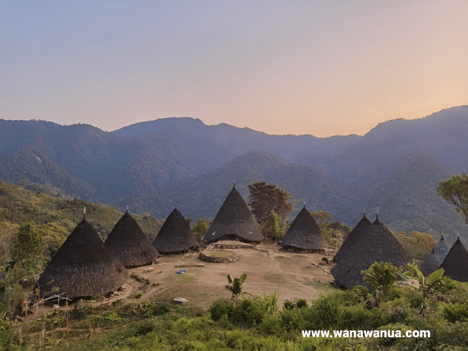
The mbaru niang rises from the earth of western Flores as a cone of dark palm fibre. Step back and take it all in: the single door, the buffalo horns at the apex, the ring of houses around the stone altar, the spider-web fields spreading through the valleys beyond.
Every element connects to every other. The siri bongkok mirrors the lodok of the lingko fields. The compang at the centre of the village mirrors the hearth at the centre of the living floor. The six levels of the house mirror the six layers of Manggarai cosmology — from the realm of the dead below, through the world of the living in the middle, to the world of the ancestors above.
This is a civilisation that thought deeply and carefully about where it lived — and then built that thinking into its buildings. The mbaru niang teaches something that modern architecture often forgets: the finest buildings are not the most impressive ones. They are the ones that most faithfully reflect the life of the people inside them — their relationships, their values, their place within the natural world, and their obligations to those who came before and those who will come after.
“The central post of the mbaru niang — the siri bongkok — stands from the earthen floor to the tip of the cone, connecting the living world to the ancestors below and the sky above. In Melo, Todo, Ruteng Pu’u, and Waerebo, that post is still standing. Its meaning is not fixed. It must be renewed, argued for, performed. In the life of these communities, the mbaru niang has never been simply a place to sleep. It is a place to make sense of what it means to live together — and to keep making that sense, for every generation that follows.”
—That is not just architecture.—
—That is wisdom you can touch.—
Glossary of Key Manggarai Terms
| Manggarai Term | Meaning | Significance |
| Mbaru niang | Tall, round house | The traditional conical house |
| Mbaru gendang | Drum house | The clan’s ceremonial house |
| Compang | Sacred stone altar | The cosmological and territorial centre of the village |
| Pu’u | Trunk / origin / root | Ancestral claim and legitimacy |
| Siri bongkok | Central post | Structural spine and cosmic axis of the house |
| Siri leles | Eight outer support posts | The ring of columns surrounding the central post |
| Hapo | Hearth / fire | The centre of family life on the living floor |
| Ngaung | Under-floor space | The underworld; storage for tools and implements |
| Tenda / Lutur | Ground floor | The human living space |
| Lobo | Second floor | Provisions storage |
| Lentar | Third floor | Emergency food reserve |
| Lempe Rae | Fourth floor | Seed storage — the future of the community |
| Hekang Kode | Top floor | Ancestral altar; the sacred realm |
| Rangga kaba | Buffalo horns | Symbol of strength and devotion to Mori Kraeng |
| Lingko | Spider-web rice fields | Communal land division; cosmic mirror of the house |
| Lodok | Centre of the lingko | The field’s equivalent of the siri bongkok |
| Tu’a | Elder / master craftsperson | Keeper of building knowledge |
| Adat | Customary law | The living system of community rules and values |
| Mori Kraeng | The Lord / God | The highest spiritual reality in Manggarai belief |
| Wa’u | Clan | The primary unit of Manggarai social organisation |
| Lonto leok | Sitting in a circle | The Manggarai practice of communal deliberation |
| Kaba | Buffalo | The sacred symbol of strength and sacrifice |
| Gendang | Drum / drum house | Ceremonial instrument; also the name for the clan house |
— Wana Wanua —
Research & Assessment Programme
The independent research and assessment program is one of Wana Wanua’s programs operating throughout the Indonesian archipelago. Our work sits at the intersection of four interlocking fields: indigenous cultural heritage, Traditional Ecological Knowledge (TEK), living customary systems, and community-based cultural documentation. We work alongside local communities to record, preserve, and bring to wider attention the knowledge systems, spatial practices, ritual landscapes, and built environments that define indigenous life in Indonesia — knowledge that is alive, adaptive, and irreplaceable.
Our research recognises that Traditional Ecological Knowledge — the accumulated understanding of local ecosystems, land use, biodiversity, and environmental relationships developed by communities over generations — is not a relic of the past. It is a living, practised, and continuously evolving body of wisdom that holds critical answers to questions about sustainable land stewardship, climate resilience, and community governance. Across Indonesia’s thousands of islands, this knowledge is embedded in architecture, agricultural systems, ritual practice, oral tradition, and the social organisation of daily life.
Through fieldwork, community engagement, and cross-disciplinary assessment, Wana Wanua documents these knowledge systems before they are lost — and advocates for their recognition within national heritage policy, environmental law, and indigenous rights frameworks. We believe that understanding who a people are begins with understanding where they live, how they build, and what their landscape means to them. Understanding where they live, how they build, and what their landscape means to them.
Written by : Naning Sudiarsih
 Wana Wanua
Leave a comment