
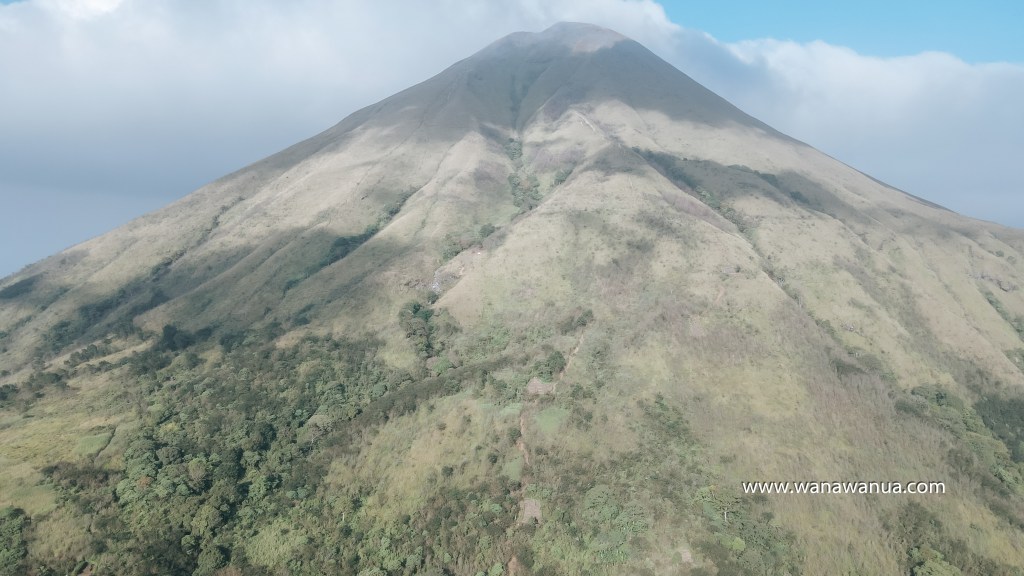
Mount Penanggungan, an ancient volcanic formation in East Java, Indonesia, stands as a testament to the intricate relationship between human culture, architectural innovation, and environmental adaptation in the context of ancient Javanese civilization. This essay explores the sacred landscape of Mount Penanggungan, examining how its unique geographical features influenced religious practices, architectural designs, and cultural symbolism from the 10th to 15th centuries CE. By analysing the mountain’s various archaeological sites, including temples, water sanctuaries, and inscriptions, we can gain valuable insights into the complex interplay between natural environment and human cultural expression in ancient Java.
The Geographical and Cultural Significance of Mount Penanggungan
Mount Penanggungan, rising to 1,653 meters above sea level, holds a distinctive place in both the physical and cultural landscape of East Java. Its unique topography, featuring a central peak surrounded by eight smaller peaks, contributed to its identification in ancient Javanese literature as a terrestrial representation of Mount Meru, the cosmic mountain in Hindu-Buddhist cosmology. This geographical peculiarity imbued Penanggungan with profound religious significance, transforming it into a sacred space that attracted pilgrims, ascetics, and royal patronage over several centuries.
The mountain’s location near the intersection of several important ancient Javanese kingdoms, including Mataram and Majapahit, further enhanced its cultural importance. As a result, Penanggungan became a focal point for religious and political expression, evidenced by the numerous temples, hermitages, and inscriptions found on its slopes. The concentration of these structures not only reflects the mountain’s sacred status but also provides a unique opportunity to study the evolution of Javanese religious architecture and its adaptation to a challenging mountainous environment.
Sima Establishments and Their Cultural Implications
One of the most significant aspects of Mount Penanggungan’s cultural landscape is the establishment of three important sima (tax-free religious domains) on its slopes between the 10th and 11th centuries CE. These sima – Tulangan, Cunggrang, and Pucangan – offer crucial insights into the political, economic, and religious dynamics of the period.
The Tulangan sima, established by King Balitung in 910 CE, likely served security purposes and was located on the northern slope of Penanggungan. The presence of the Jedong gateway, Pasetran temple, and an ancient spring in this area suggests a complex interplay between political control, religious practice, and natural resource management. The strategic location of this sima indicates a deliberate effort to integrate sacred geography with practical concerns of territorial control and resource access.
The Cunggrang sima, established by Mpu Sindok in 929 CE, recognized the local population’s role in maintaining sacred sites on the mountain. This arrangement highlights the symbiotic relationship between local communities and religious institutions, demonstrating how the sacralization of landscape could be used to reinforce social bonds and political loyalty. The presence of the Belahan bathing place within this sima further underscores the integration of ritual purification practices with the natural features of the mountain.
Lastly, the Pucangan sima, established by King Airlangga between 1037 and 1042 CE, represents a fulfillment of a royal vow following military victories. This act of royal patronage not only reinforced the mountain’s sacred status but also tied it to narratives of political legitimacy and divine favor. The association of this sima with the Jalatunda water sanctuary emphasizes the continued importance of water in Javanese ritual practices and its integration with the mountain’s natural hydrology.
The establishment of these sima demonstrates how Mount Penanggungan functioned as a nexus of political, economic, and religious power. By designating these areas as tax-free religious domains, the rulers not only patronized religious institutions but also created a network of loyal supporters in a strategically important region. This practice illustrates the sophisticated ways in which ancient Javanese rulers manipulated sacred geography to consolidate their authority and create lasting legacies.
Architectural Adaptation and Religious Expression
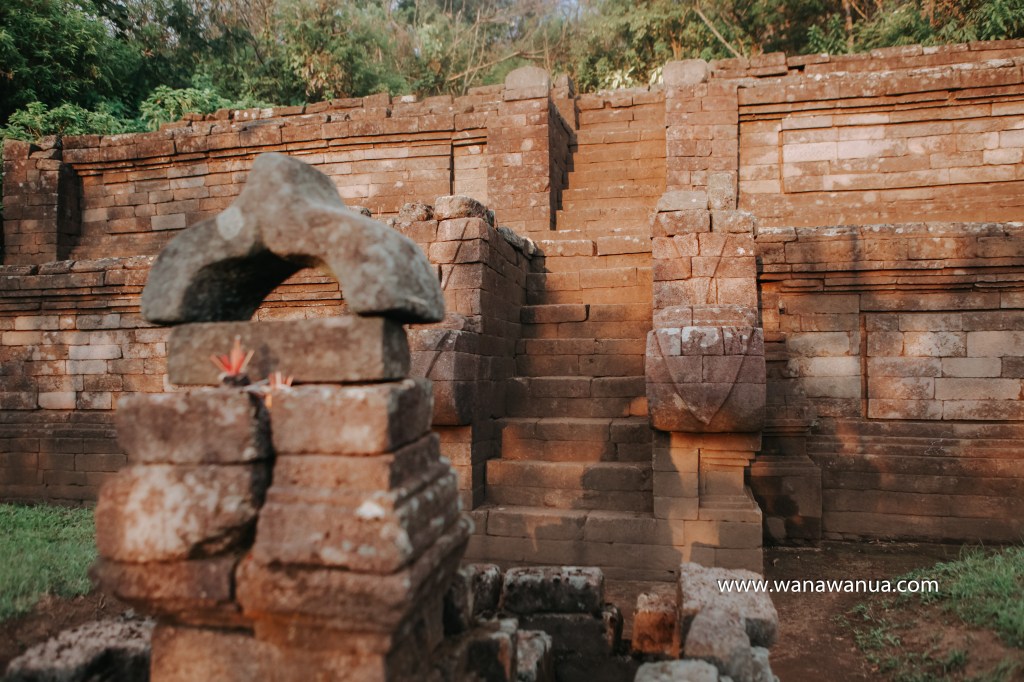
The archaeological remains on Mount Penanggungan reveal a remarkable diversity of architectural forms, ranging from terraced sanctuaries and cave hermitages to more elaborate temple structures. This variety reflects not only the different religious traditions practiced on the mountain but also the ingenious ways in which ancient Javanese architects adapted their designs to the challenging mountainous terrain.
One of the most distinctive features of Penanggungan’s sacred architecture is the prevalence of terraced sanctuaries, or punden berundak. These step-pyramid structures, which differ significantly from the more elaborate Central Javanese temples, represent a unique architectural response to the mountain’s steep slopes. The terraced design not only provided stability on uneven terrain but also symbolically recreated the ascent of Mount Meru, reinforcing the mountain’s cosmic significance.
The integration of natural cave formations into the sacred landscape is another notable aspect of Penanggungan’s religious architecture. These caves, often modified with carved entrances or supplemented with constructed elements, served as hermitages and meditation sites. Their use reflects the importance of ascetic practices in ancient Javanese religion and demonstrates how natural features were incorporated into the sacred geography of the mountain.
Water management and ritual purification also played a crucial role in shaping Penanggungan’s architectural landscape. The presence of elaborate bathing places, or petirtaan, such as Belahan and Jalatunda, highlights the importance of water in Javanese religious practices. These structures not only served practical purposes but also symbolized the purifying power of water and its association with divine forces. The integration of these water sanctuaries with the mountain’s natural springs and streams demonstrates a sophisticated understanding of hydrology and its ritual significance.
The diversity of architectural styles and forms found on Mount Penanggungan also reflects the syncretism characteristic of ancient Javanese religion. Elements of Hindu and Buddhist iconography coexist with indigenous Javanese motifs, creating a unique visual vocabulary that speaks to the complex religious landscape of the period. This syncretism is particularly evident in the relief carvings and statuary found at various sites on the mountain, which often blend different religious traditions in innovative ways.
Symbolism and Ritual in the Sacred Landscape
The sacred landscape of Mount Penanggungan is rich in symbolism, with each architectural element and natural feature imbued with multiple layers of meaning. The mountain itself, with its central peak and surrounding smaller summits, was seen as a microcosm of the Hindu-Buddhist universe, with the central peak representing Mount Meru and the surrounding peaks symbolizing the eight guardian deities of the cardinal and intercardinal directions.
This cosmic symbolism is reflected in the placement and design of various structures on the mountain. For example, the positioning of temples and hermitages at different elevations may have corresponded to different levels of spiritual attainment or stages of the soul’s journey. The ascent of the mountain, therefore, could be interpreted as both a physical pilgrimage and a symbolic spiritual journey towards enlightenment.
The use of dual gateways, such as the Gapura Lanang and Gapura Wedok, reflects the Javanese concept of dualism and the balance between opposing forces. These gateways not only served as physical demarcations between sacred and profane spaces but also symbolized the transition between different states of being. Their design and placement demonstrate how architectural elements were used to reinforce cosmological concepts and guide ritual behavior.
The presence of lumpang, or stone mortars, at various sites on the mountain adds another layer of ritual significance to the landscape. While these objects had practical uses in food preparation, their presence in sacred contexts suggests a ritual function, possibly related to the preparation of offerings or the symbolic grinding of the ego in spiritual practices. The integration of such everyday objects into the sacred landscape highlights the holistic nature of ancient Javanese spirituality, where the mundane and the divine were intimately connected.
Environmental Adaptation and Sustainability
The sacred sites of Mount Penanggungan offer valuable insights into how ancient Javanese societies adapted to and sustainably managed their environment. The terraced design of many structures not only provided stability on steep slopes but also helped manage water runoff, preventing erosion and conserving soil. This architectural approach demonstrates an advanced understanding of mountain ecosystems and the need for sustainable building practices in fragile environments.
The integration of natural springs and streams into ritual bathing places and water sanctuaries reflects a sophisticated approach to water resource management. These structures not only served religious purposes but also acted as water storage and distribution systems, helping to regulate water flow and ensure a steady supply for both ritual and practical uses. This dual functionality highlights the pragmatic aspects of ancient Javanese sacred architecture and its role in environmental stewardship.
The use of local materials in construction, such as andesite stone quarried from the mountain itself, minimized transportation costs and environmental impact while creating structures that harmonized with their natural surroundings. This practice not only demonstrated resourcefulness but also reflected a deep respect for the mountain’s inherent sacredness, with each structure becoming an integral part of the sacred landscape.
Conclusion
The sacred landscape of Mount Penanggungan stands as a remarkable example of the complex interplay between culture, architecture, and environment in ancient Java. Through its diverse archaeological remains, we can trace the evolution of religious practices, architectural innovations, and environmental adaptations over several centuries. The mountain’s transformation into a cosmic landscape reflects the sophisticated ways in which ancient Javanese societies manipulated their environment to express religious beliefs, consolidate political power, and create enduring cultural legacies.
The study of Mount Penanggungan’s sacred sites offers valuable lessons for contemporary discussions on cultural heritage preservation, sustainable architecture, and the relationship between spirituality and environment. By examining how ancient societies integrated their beliefs and practices with the natural world, we gain insights into more holistic approaches to environmental management and cultural expression.
As we continue to uncover and interpret the secrets of Mount Penanggungan, we are reminded of the enduring power of sacred landscapes to shape human culture and imagination. The mountain’s legacy challenges us to consider how we, in our modern context, can create meaningful connections between our built environment, natural world, and cultural values, fostering a more sustainable and spiritually enriching relationship with the landscapes we inhabit.
Blog written by Naning Sudiarsih
Visual stories can be accessed on our YouTube channel https://youtu.be/72-nc-Mpv1M?feature=shared
 Wana Wanua
Leave a comment